
Chambersburg, PA · Garage Door Service
What Your Chambersburg Garage Door Is Up Against
Chambersburg's housing dates mostly to 1938-1998 with cold-severe winters. Here's what that means for your door, what it costs, and what can wait.
- Repairs & new doors
- Springs & openers
- Serving 6 nearby communities
What Is Going On
Most of the houses in Chambersburg went up between 1938 and 1998, with the typical home dating to 1970 - before anyone built insulation rules into the garage door itself. That's not a guess about one street; it's the shape of the housing stock across all 22 named areas that make up this market, where 1960s and 70s construction is the norm rather than the exception.
What that means on a service call: doors on houses built before insulation rules were common. Single-layer steel skins with no thermal break, springs sized for lighter sectional doors that have since been swapped for heavier insulated replacements without re-checking the spring rate, and openers from renovations that don't match the track hardware underneath them. None of this is a defect - it's just what happens when a door and its house age on different timelines.
The most common call we get isn't a dead opener. It's a torsion spring that's worn out from running a door it was never rated for, on a house where the rest of the system - track, rollers, cable drums - is original to a build from the Johnson or Nixon era. You can't fix the spring in isolation and expect the rest to hold.
What It Costs
We're not going to put a number here that doesn't match your door, because the honest range depends on what's underneath the paint - original 1960s track and drums cost more to source parts for than a door replaced in the last decade. A straightforward spring swap on common hardware is one job. A spring swap on an original torsion system where the shaft, drums, or end bearing plate are also original is a different job, because we may need to source or adapt parts for hardware nobody manufactures anymore.
With a median household income of $74,723 across the area, most owners we talk to want a straight answer before we touch anything: repair if the drum and shaft are sound, replace if the track is bent or the door itself has delaminated insulation. We'll tell you which one you're looking at before we quote it, not after.
When Waiting Is Fine
Not every noisy door is an emergency. A door that's loud but still opens and closes square, with no visible fraying on the cables and no gap where the bottom seal meets the slab, can usually wait for a scheduled visit rather than an after-hours call. If the opener struggles but the door moves fine by hand, that's an opener problem, not a structural one, and it won't strand your car overnight.
Where we tell people not to wait: a cable that's starting to fray, a door that's visibly off-square in the track, or a spring that's already made the loud bang that means it's broken, not just worn. On the original 1960s-70s hardware common here, a broken spring under tension on an old shaft is the one thing that turns a $200 problem into a $700 one if the shaft bends from running unbalanced.
What the Weather Here Does to It
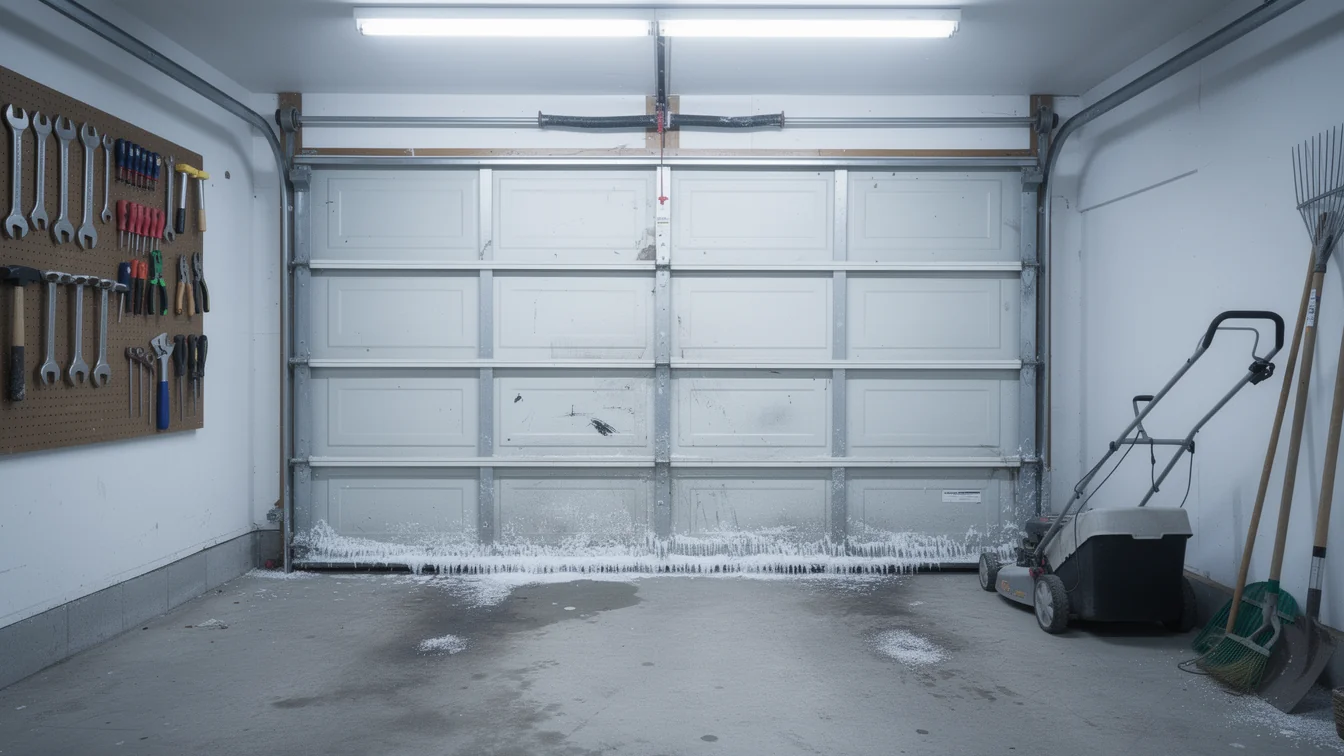
Chambersburg sits in a cold-severe climate band, which means a steel door without a thermal break turns the garage into a 20-degree gap in your house's envelope every winter. On the original uninsulated doors still common on houses from the 1960s and 70s, that's not a comfort issue only - it's condensation on the inside skin, rust starting at the bottom panel seam, and springs that get stiffer and more likely to snap in a cold snap than they would in a mild one.
With 16,825 owner-occupied houses in the service area, most of them raised before insulation codes applied to garage doors, this is not a niche problem. Cold makes steel brittle and lubricant thick, which is why most of the broken-spring calls we take cluster in the coldest weeks rather than spreading evenly across the year. If your door is original to a 1970-era build, the cold isn't creating a new problem - it's finding the weak point that was already there.
Frequently asked questions
Why does my spring keep breaking in winter specifically?
Cold makes steel more brittle and thickens the lubricant on the coils, so a spring that's already near the end of its cycle life is more likely to snap in a cold stretch than a mild one. On original hardware from a 1960s or 70s build, that spring has often already outlived its rated cycles before winter even tests it.
Is it worth insulating an old garage door instead of replacing it?
Depends on the door. If the panels and track are sound, a retrofit insulation kit can help with the thermal gap on a cold-severe winter. If the steel skin has started rusting at the seams or the panels have warped, insulation won't fix the structural issue and replacement is the better money.
How do I know if my door's hardware is original to the house?
If the house dates to the 1960s or 70s and nobody's mentioned a door replacement, the torsion shaft, drums, and end bearing plate are likely original. We check this on-site before quoting a repair, since parts for that era aren't something every supplier stocks.
Related garage door services in Chambersburg
More garage door guides
Book garage door service in Chambersburg
Call now or request a quote - tell us what the door is doing and where you are.