
Chambersburg, PA · Garage Door Service
What a Service Call Actually Covers in Chambersburg
A plain look at what a garage door service call actually involves in Chambersburg, tied to the area's 1960s-70s housing stock and cold winters.
- Repairs & new doors
- Springs & openers
- Serving 6 nearby communities
What Is Going On
When we get a call in Chambersburg, the first ten minutes aren't about tools, they're about figuring out what decade your door is from. Most houses in this service area went up between 1938 and 1998, with the typical build year landing around 1970, and across the 22 named areas we cover the stock skews heavily 1960s and 70s. That matters because a door from that era is usually on different hardware than anything sold new today - extension springs instead of torsion, lighter-gauge track, sometimes a single-piece panel that doesn't exist in current catalogs.
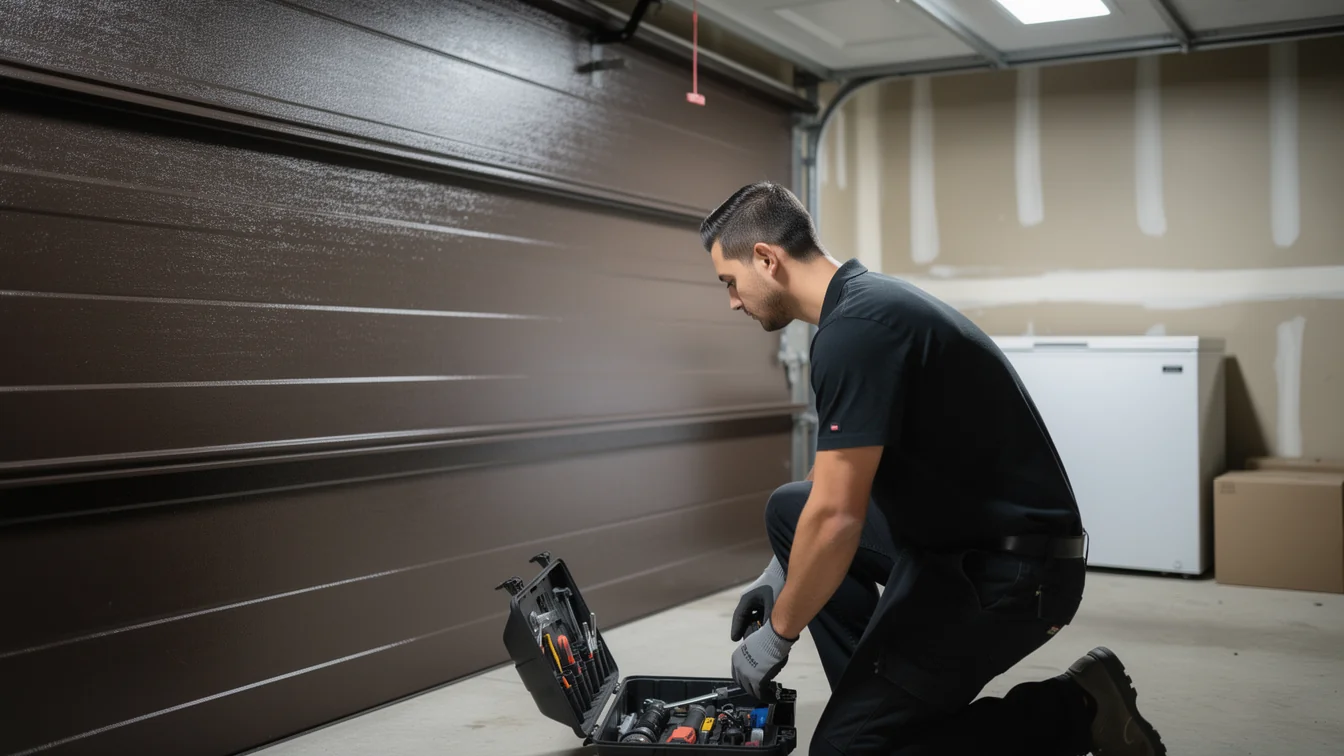
A service call starts with us opening the door by hand, watching how it travels, and listening to what the springs and rollers are doing under load. We check the track alignment, the cable condition, the bottom brackets, and whether the opener (if there is one) is actually matched to the door's weight or just bolted on and hoped for. On a house this age, half the job is diagnosis: is the spring tired, or is the track bent from decades of settling, or both. We don't quote a fix until we've actually seen the door move.
What It Costs
We're not going to put a number here that doesn't match what shows up on your invoice, because that number depends on what we find once we're under the door - spring size, track length, whether the opener needs replacing too. What we can tell you is what drives the cost up or down in this area specifically: houses built in the 1960s and 70s often need parts that aren't on the shelf at a standard supply house, which can add a trip or a day to the job compared to a door built last year.
Income and household data for this service area (median household income $74,723, with 16,825 owner-occupied houses among 30,672 households) tells us most calls here are homeowners deciding between a repair and a replacement on a door that's been fine for decades and just hit a rough patch. We'll tell you straight which side of that line your door is on. If the torsion shaft or the track is original to a 1970-built house, patching one part while the rest is near failure usually costs more in the long run than doing it once.
When Waiting Is Fine
Not every noise or stiff spot means call today. A door that's slow to open but still tracks straight, with no fraying on the cables and no visible bend in the rail, can usually wait a week or two for a scheduled visit rather than an emergency one. Same goes for a spring that's just starting to sag - if the door still opens and closes under its own power without the opener straining, you've got time.
Where we'd push you not to wait: a cable that's starting to unravel, a door that slams the last foot of travel, or an opener that's reversing on its own. Those get worse fast and they get worse at the worst moment, usually the first cold morning of the season. On a house built in the 1960s or 70s with original hardware, we'd rather see it before a part fails outright than after, since matching parts isn't always a same-day thing in this area.
What the Weather Here Does to It
Chambersburg sits in a cold climate band that the data classifies as severe, and that shows up on a garage door in specific ways. Steel contracts in the cold, which tightens tolerances on tracks that were already a little loose from fifty years of use. Lubricant that was fine in August turns gummy by January, and a spring under tension behaves differently at 15 degrees than it does at 70 - it's stiffer, and it's more likely to snap on a cold morning than a warm one if it was already near the end of its life.
On older doors, especially the single-piece and lighter-gauge styles common in this area's 1960s and 70s housing, cold also makes existing wood or metal panel warp more noticeable, since the door is expanding and contracting against hardware that was never adjusted for it. We check weatherstripping and bottom seals on every winter call for exactly this reason - a worn seal lets cold air track moisture onto hardware that's already fighting the temperature swing.
Frequently asked questions
Does my house's age affect what parts you bring on the truck?
Yes. Since most houses in this service area were built between 1938 and 1998 with a median around 1970, we often bring both older-style extension spring hardware and newer torsion components to a first visit, because we won't know which one your door uses until we're there.
Is a slow garage door an emergency?
Not usually. If it still opens and closes fully under its own power, with no fraying cables or bent track, it can typically wait for a scheduled visit rather than a same-day call.
Why does my door act up more in winter?
This area sits in a severe cold climate band, and steel springs and track tighten and stiffen in low temperatures. A spring that was already near the end of its life is far more likely to fail on a cold morning than during a warm stretch.
Do you always recommend replacing an old door instead of fixing it?
No. We look at what's actually failing. A single bad spring or a dented panel on an otherwise sound 1970s door is usually a repair, not a replacement - we only push replacement when the hardware underneath is failing as a whole.
Related garage door services in Chambersburg
More garage door guides
Book garage door service in Chambersburg
Call now or request a quote - tell us what the door is doing and where you are.